Geraldine Hoad from the Macular Society joined our Live Well session to talk about the latest research in Macular Degeneration. In this video she talks about the latest drugs, stems cell research, and gene therapy and answers viewers’ questions.
00:00 – Start
00:51 – Introduction
01:29 – Geraldine Intro
03:23 – New Drugs for Wet AMD
08:13 – Question – Drugs for PXE
09:12 – Questions – Treatments to reverse disease
09:44 – Dry AMD
16:00 – Question – Nutritional Supplements for Macular Degeneration
18:52 – Stem Cell Treatments
24:43 – Question – Stem Cell Treatments
27:53 – Gene Therapy
31:57 – Question – How to get on the trial?
33:33 – Question – Most promising treatment
35:56 – Question – Diabetic Retinal Screening
37:24 – Comment – PXE and Dry MD
Vicky, who has Stargardt’s Macular Degeneration, rediscovered her love of photography during the pandemic restrictions using an iPhone 7 plus, she went out and about taking pictures around her local area in south London, discovering the full potential of its camera, including using Voiceover and Voice Control.
In this video, Vicky will demonstrate the basic iPhone camera functions
00:00 – Start
00:56 – Intro
01:19 – Vicky Introduction
03:11 – Background Story
05:30 – My Love of Photography
09:29 – iPhone Photography as a VIP
10:29 – Opening the Camera
11:25 – Description Opening Camera from Lock Screen
14:11 – Opening Camera from Home Screen
15:41 – How to take a Picture
18:57 – Tips in using VoiceOver
20:58 – Demo – Using VoiceOver to take Photos
23:12 – Using your Voice to Take Photos
24:32 – Demo – Taking a picture using your Voice
25:34 – Guide to the Camera App
25:39 – Camera Modes
25:43 – Photo MOde
25:48 – Portrait Mode
29:11 – Pano (Panorama) Mode
29:51 – Burst Mode
32:54 – Camera Control
33:11 – Live Mode
33:47 – Flash
33:54 – Timer
34:14 – Advanced Camera Controls
34:27 – Aspect Ratio
34:48 – Lo Light
35:09 – Photographic Styles
35:45 – Exposure
36:14 – Image Description in the Photos App
38:33 – Tips and Tricks
53:18 – Questions
53:58 – Question – Live Photos
54:32 – Question – How to save one photo from Burst
56:04 – Question – How to record Video
57:05 – Experiences of Photography when Partially Sighted and Blind
01:01:53 – Using an Ipad to take photos
Liz Ball and Robyn Aprey from Glaucoma UK joined us to talk about what glaucoma is and how to get the best out of your eye drops. Followed by a Question and Answer session.
00:00 – Start
00:49 – Intro
01:17 – Intro Liz Ball
02:08 – About Glaucoma UK
03:56 – What is Glaucoma
07:31 – Eye Pressure
11:21 – Types of Glaucoma
19:28 – How to treat Glaucoma
20:40 – Why do I need to use Eye Drops
22:01 – What do Eye Drops Do
22:39 – When should I use them
26:22 – How do I store my eye drops
29:20 – How should I use my Eye Drops
30:48 – Tips for Applying Eye Drops
33:48 – Side effects of Eye Drops
37:33 – Frequently Asked Questions
39:22 – Advice and Support Services
44:49 – Quesions & Answer Session
45:31 – Question – Glasses for administering Eye Drops
47:16 – Question – Insertion of Stents into the Eye
49:27 – Question – Difficulty getting appointments
52:14 – Question – Emotional Support
56:10 – Question – Cataracts with Glaucoma
58:55 – Question – Fluctuating Vision
01:02:11 – Question – Impact of food and other medications
01:04:14 – Questions – Research into Glaucoma
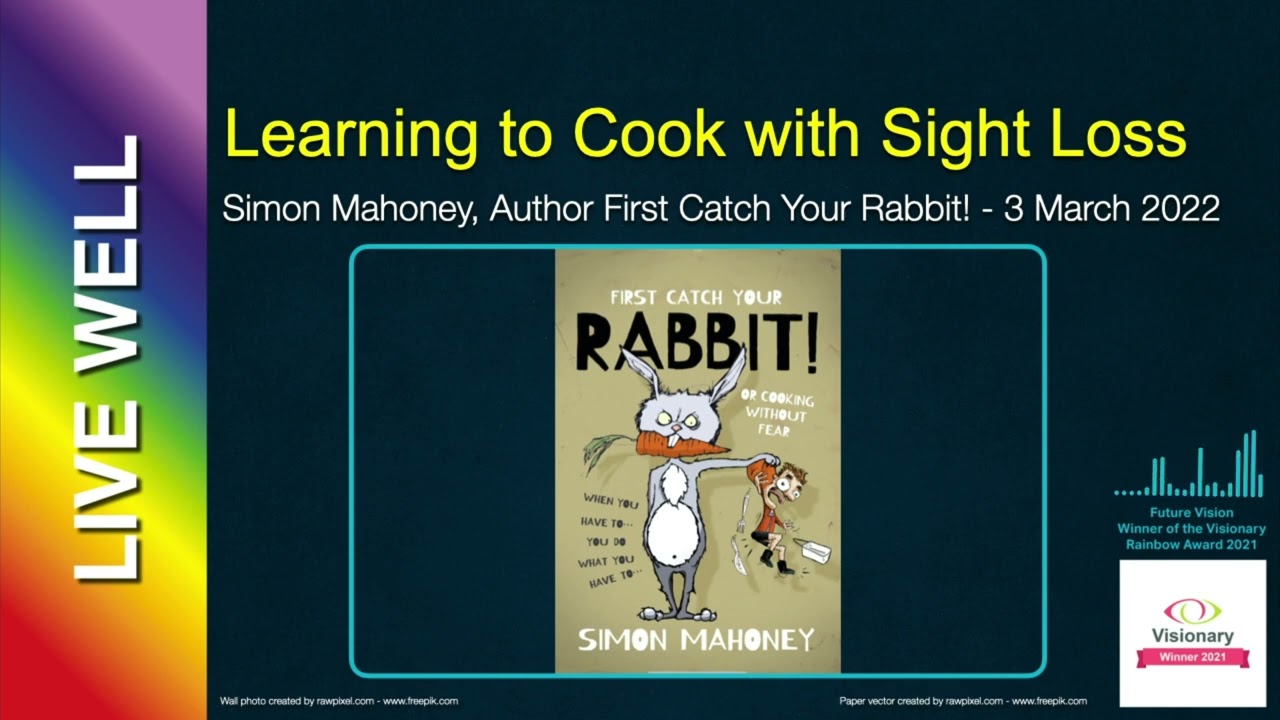
How do you cook when you’re totally blind, and your wife dies at the start of a Pandemic? This was the situation faced by former Royal Marine Simon Mahoney in March 2020. His solution was to write a basic Kitchen survival guide called “First Catch your Rabbit” In this talk, Simon will tell his story, how he organised his kitchen, and talk through the process of preparing a meal using the system he devised.
Simons Books
A Descent Into Darkness
First Catch your rabbit!
Winging it Blind
For more details, visit Simon’s website at www.wingingitblind.com
00:00:00 Start
00:00:54 Intro
00:01:18 Simon Mahoney
00:01:37 Simon’s Story
00:04:08 First Book Descent into Darkness
00:04:27 Winging it Blind
00:05:14 Organising the Kitchen
00:06:24 Developing a System
00:07:33 First Catch your Rabbit
00:08:27 KISS & SLOPE
00:09:36 Safety
00:11:03 Lazy Person Principle
00:12:43 Organisation
00:13:26 Prepare
00:15:41 Execution
00:17:02 Why SLOPE is important
00:19:54 Cooking Economically
00:22:19 Making a Quiche
00:26:57 Questions
00:27:02 Question – How to put spreads on Toast
00:29:24 Question – How to organise your store cupboard
00:32:35 Question Managing Clothes
00:33:24 Question – Book Titles
00:33:52 Question – Book Availability
00:35:25 Website
00:35:54 Outro
Good lighting can help people with sight loss make the most of their remaining sight. In this Video Antony talks about different lighting technologies, Lighting Terminology, choosing the right light for the job and smart lighting.
My name is Hanna and I am the founder and the voice behind HERU Yoga for the Blind. I live in London and am a Choreographer, Performer, and Yoga teacher. I started HERU Yoga for the Blind in 2021 to make yoga accessible to those with visual impairments. Having a visual impairment should not be stopping anyone from benefiting from yoga. HERU Yoga for the Blind makes yoga accessible through the medium of podcasts. Currently, there is one season with 27 different episodes/sequences and season number 2 is in the making.
00:00 – Start
00:46 – Introduction
01:20 – Hanna Introduction
02:21 – How the Podcast Started
07:32 – What to expect
11:56 – Breathing Exercise
23:10 – Question – How to find the Podcast
25:44 – Question – How do I find the podcast
27:51 – Question – Are you on YouTube?
28:26 – Question – Availability off line
29:54 – Question – Using an Ipad to listen to the podcast
30:35 – Comment – Subscribing to Podcasts
34:15 – Comment – What are podcasts
In this video, Mark Owen and David Quarmby from Outlookers in Huddersfield looks at how to make the most of your mobile phone when you have sight loss. Mark and David look at making the contents of the screen easier to see, making the screen bigger, using the phone as a magnifier, and using the phone to read printed text. Using the phone with a screen reader.
00:00 – Start
00:50 – Intro
01:04 – Mark Owen Intro
04:15 – Making a phone easier for someone with low vision
05:27 – Making the font bigger
06:08 – Dark Mode
08:16 – Invert on Older Phones
09:00 – Making Icons Easier to Find
10:21 – Remove unwanted Apps
11:49 – Question – High Contrast
14:48 – Question – Phone Lifespan
16:05 – Screen Enlargement
18:29 – Using the phone as a magnifier
22:40 – Question – Magnification on iPhone
23:32 – Reading Text
27:30 – Tip for scanning page of text
28:07 – David Quarmby Intro
28:42 – Screen Readers
29:12 – Getting Familiar with the design of the phone30:29 – Starting to use speech
30:52 – Touch Gesture
31:29 – Double Tap
32:28 – Flick Left/Flick Right
33:28 – Turning VoiceOver on and Off
36:09 – Using your voice to control the phone
37:30 – Question – Difference between Apple and Android
40:09 – Comment – Using an iPhone without a Home Button
41:25 – Question – Answering Calls on WhatsApp
45:21 – Question – Quickest Way to Read Text Messages
47:34 – Question – Using your voice to answer Whatsapp Calls
47:57 – Outro
Charles Bonnet Syndrome is a condition where people with sight loss experience visual hallucinations. In this talk, Judith Potts of Esme’s Umbrella will give an overview of Charles Bonnet Syndrome and also explain some of the very new and exciting developments in research in this area.
Esme’s Umbrella www.charlesbonnetsyndrome.uk
00:00 – Start
00:53 – Intro
01:22 – Judith Potts
01:33 – Esme’s Story
05:44 – What is Charles Bonnet Syndrome
07:57 – The Launch of Esme’s Umbrella
09:10 – Esme’s Rooms Support Groups
09:40 – Esme’s Friends Telephone Support Groups
10:45 – Coping Strategies
10:56 – Medication
11:13 – Factors that make CBS worse
13:08 – Research into CBS
13:12 – How Charles Bonnett Syndrome was Discovered
15:14 – Dr Kat De Silva Newcastle University – Comparing the Brains of people with sight loss who have CBS with those who don’t
16:22 – Getting CBS recognised as a condition in its own right
17:33 – Dr Jasleen Jolly – Brain Activity during Hallucinations
18:42 – Dr Matt Dunn – The Role of Peripheral Vision
19:12 – Prof Mariya Moosajee – The effects of Lockdown on Charles Bonnett Syndrome
20:07 – Children with Charles Bonnett Syndrome
21:21 – Falls in people with Charles Bonnet Syndrome
22:33 – Using Dogs to warn of impending hallucinations
25:13 – The Future
25:27 – More research needed
25:55 – NHS Pathway for Charles Bonnet Syndrome
26:51 – #WiseUp2022 Campaign
27:48 – Questions
27:52 – Question – Triggers for Hallucinations
30:20 – Question – Prevalence in acquired sight loss in comparison to congenital sight loss
32:45 – Question – Charles Bonnet in people with Dementia
33:33 – Question – Being woken up by hallucinations
36:58 – Question – Charles Bonnet Syndrome in people with both Sight and Hearing Loss
39:08 – Experience of Hallucinations
42:53 – Question – Has the pandemic increased incidents of CBS
44:32 – Question – Is it the brain looking for stimulation
46:59 – Question – Are hallucinations of people dead relatives
49:45 – Experience of Hallucinations
50:59 – Coping Strategies
52:39 – Question – Does CBS occur when dreaming
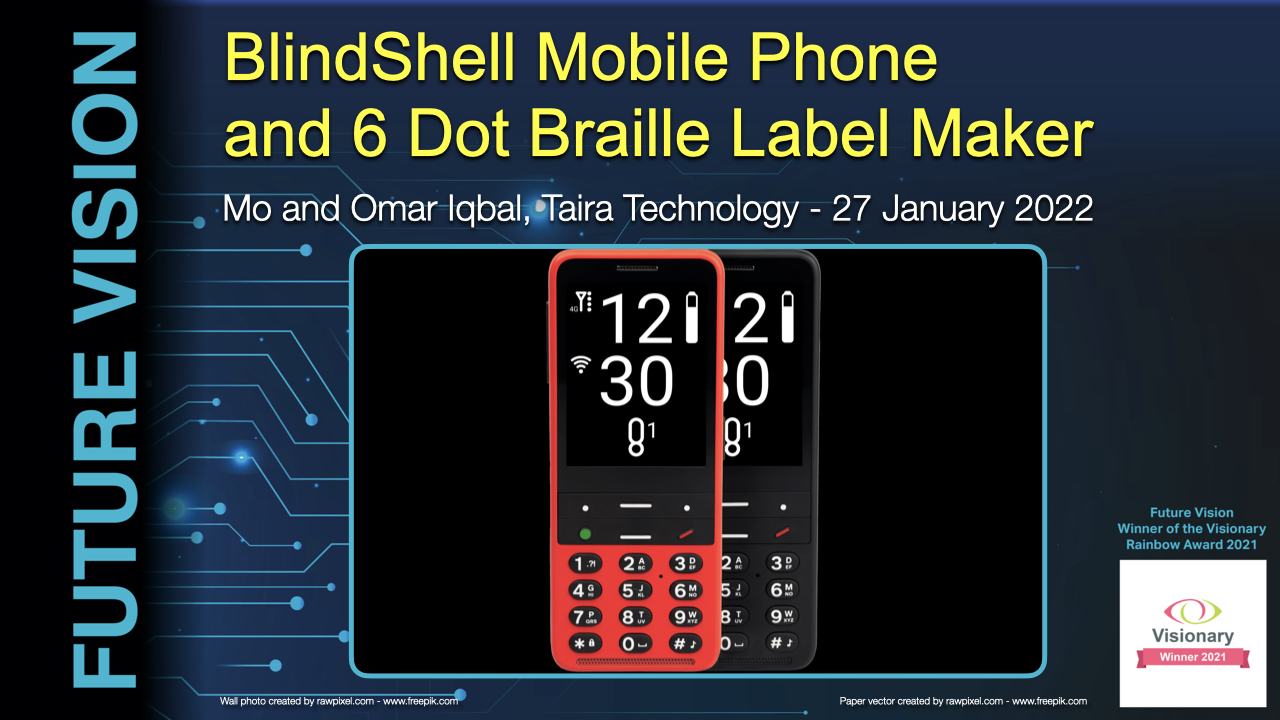
Mo and Omar Iqbal from Taira technology provide a demonstration of the BlindShell Classic 2 talking mobile phone (starts at 16:19). Taira Technology specialises in providing technology, support and training to people who are visually impaired.
00:00 – Start
01:03 – Intro
01:31 – Omar Introduction
01:57 – Background to Taira Technology
03:07 – Products and Services
03:25 – TVOnics set-top box repair
04:13 – Advice, Training and Support
06:02 – Braille Transcription
06:29 – Laptop and Desktop Computers
08:55 – Demonstration – 6 Dot Braille Label Maker
12:34 – Speed Dots Cover
15:02 – Android Phones
16:19 – BlindShell Classic Mobile Phone
16:50 – Dimensions
17:07 – Accessibility Features
17:21 – Core Functions
18:45 – Advanced Features
20:08 – Support for Third-Party Apps
22:27 – BlindShell Classic 2 v BlindShell Classic
24:11 – Demonstration
32:33 – NFC Tags
32:54 – BlindShell Beeper
34:13 – Cases
34:28 – Pricing
36:03 – Contact Details
37:32 – Questions
37:37 – Question – Cost of Support Package
39:11 – How does BlindShell compare to Synapptic
40:14 – Question – Voice Control
Suzanne Roberts of The Macular Society talks about the emotional effects of macular degeneration, both before the pandemic and effects the pandemic may have had on peoples lives.
00:00 – Start
00:31 – Introduction
01:39 – Suzanne Introduction
02:29 – About the Counselling Service
03:09 – How to Access the Counselling Service
03:32 – How the Counselling Service Works
05:30 – Eligibility to use the Counselling Service
06:38 – Emotional Impact of DIagnosis
08:27 – Impact of the Pandemic
09:50 – Other issues in addition to Macular Degeneration
10:20 – Types of People Accessing the Service
13:58 – Common Themes in Living with Sight Loss
14:39 – Shock and Fear
15:52 – Denial
16:31 – Anger
17:02 – Dispair
17:35 – Acceptance
19:17 – Client Experience – Diagnosis
20:37 – Importance of Emotional Support at Diagnosis
22:08 – Outcome of the Case Study
23:19 – Discussion
23:31 – Experience of Bad Diagnosis
25:22 – Experiences of Telephone Appointments
27:16 – Not allowing companions into appointments
29:13 – Accessing Community Optician Services
29:43 – Visiting Hospitals when Clinically Extreamly Vulnerable
30:46 – Followup Appointments
33:26 – Invisible Disabilities
34:38 – Positive Experience of prompt treatment
39:54 – Making people aware of early signs of AMD
43:11 – Dietary Considerations
47:38 – How to get a referral
47:54 – Macular Helpline No
49:37 – Outro